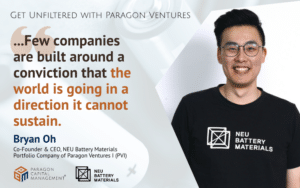
Get Unfiltered with Paragon Ventures is a candid interview series spotlighting the portfolio companies of Paragon Ventures I. Through these conversations, founders share their honest thoughts on what they’re building, the problems they’re solving, and the ups and downs along the way, offering a closer look at the people and ideas driving innovation across our portfolio. In this edition, we feature Bryan Oh, Co-Founder and CEO of NEU Battery Materials.
1. Could you share your background with us, and what inspired you to embark on the startup journey?
Kenneth and I met at the National University of Singapore (NUS) and have been building together ever since. Before NEU, we co-founded three ventures together, including a rooftop farming business. My background spans KPMG in professional services and a family with roots in the construction industry, which gave me an early appreciation for both financial discipline and the physical world of building things.
The inspiration for NEU came from a simple but unsettling realisation. The world is electrifying at speed, and this is a fundamentally good thing. But every Electric Vehicle (EV), every energy storage system, every battery-powered device will one day reach its end of life. We kept asking: where do all those batteries go? The answer was not reassuring. The dominant recycling methods are inefficient, chemically intensive, and largely unprofitable for LFP batteries, which are the fastest-growing chemistry in the world. We saw a gap that nobody was filling in a clean or scalable way, and we saw that Singapore, as a geopolitically neutral hub, was uniquely placed to be part of the solution. That was enough to start.
2. What was the toughest challenge or decision you’ve faced? How do you move forward when there isn’t a clear “right” answer?
The toughest ongoing challenge has been the pace at which the battery industry is developing. We are making high-stakes decisions about technology, capital, and team long before the market fully exists. In 2025, we surpassed performance targets we had originally set for 2028, which validated the technical path. But getting to that point required committing to a direction before the data was conclusive.
When there is no clear right answer, I try to be honest about what we know versus what we are assuming, and I size our bets accordingly. We run experiments that are large enough to be informative but not so large that a wrong result is fatal. We also stay close to first principles: does this decision bring us closer to producing the cleanest, cheapest recycled lithium in the world? If yes, we move. If not, we pause.
3. In your view, what is the “secret sauce” in building a company that stands the test of time?
Genuine conviction in the problem, not just the opportunity. A lot of companies are built around a market gap. Fewer are built around a conviction that the world is going in a direction it cannot sustain. NEU exists because Kenneth and I believe the green transition cannot be built on a new wave of waste and supply chain dependency. That conviction makes it easier to absorb the hard periods, because you are not just chasing a return.
The second ingredient is intellectual honesty. We are a deep tech company with a patented process, but we do not treat the technology as settled. Every milestone is a prompt to ask what we still do not know. That keeps us learning faster than companies that get comfortable.
4. What is one thing you do in business that might be unconventional or not widely agreed upon?
We chose to focus entirely on LFP batteries at a time when the rest of the recycling industry was ignoring them. Every commercial recycler gravitates toward NMC batteries because cobalt, nickel, and manganese command higher prices. LFP has a comparatively lower inherent material value, which makes it harder to build a business using conventional recycling economics.
We took the opposite view. LFP is the fastest-growing chemistry in the world. It dominates energy storage. It is the battery chemistry behind most EVs sold today. The end-of-life wave for LFP is coming, and nobody is ready for it. By building a process specifically optimised for LFP, we have a head start that is very difficult to replicate, both technically and in terms of the process know-how accumulated over years of development.
5. How does Neu Battery’s redox technology reshape the current Lithium extraction methodology, and what differentiates Neu Battery from other industry solutions?
Conventional recycling of LFP batteries relies on hydrometallurgy or pyrometallurgy, both of which are energy-intensive, chemically aggressive, and expensive. They were designed for NMC batteries and retrofitted for LFP, which is part of why the economics never quite work.
NEU does something fundamentally different. We developed the world’s first patented electrochemical redox recycling process for LFP batteries. Instead of dissolving battery materials in acid or smelting them at extreme temperatures, we use electrolysers to extract lithium directly, driven by electricity and water. A proprietary reagent facilitates the extraction, and crucially, that reagent is regenerated through the redox process itself, so it is not consumed. This creates a closed loop that eliminates the cost and waste of continuous chemical replenishment.
At pilot scale, our process produces 5 times lower CO2 emissions, uses 18 times less energy, and consumes 28 times less water than hydrometallurgy. We have achieved a 98% lithium extraction rate and produce battery-grade lithium. The architecture is also modular. Electrolyser units stack and scale on the same physical footprint, which means we can match market demand and deploy near gigafactories or battery collection hubs rather than centralising operations in a large, fixed plant. This reduces transport emissions, lowers logistics costs, and gives our partners supply chain flexibility that conventional recyclers simply cannot offer.
6. What do you appreciate most about Paragon Ventures?
Paragon Ventures, especially Xinhui, has been a big help to us by taking the time to understand our technology and our business. PCM’s introductions to potential investors helped us refine our pitch, strengthen our fundraising approach, and ultimately close an oversubscribed funding round.
Click here to find out more about NEU Battery